For perfumery and cosmetics houses, the ECOCERT For Life certification has become a reference point whenever a supply chain needs to be shown as genuinely responsible. It amounts to far more than a logo on a drum: it rests on an audit standard that examines, on the ground, how a raw material is grown, harvested, processed and paid for. Applied to a sandalwood supply chain such as Lifou's, in the Loyalty Islands, it gives an international buyer a verifiable guarantee, in a sandalwood market still marked by opaque origins and acute supply tensions.
The ECOCERT For Life certification, in brief
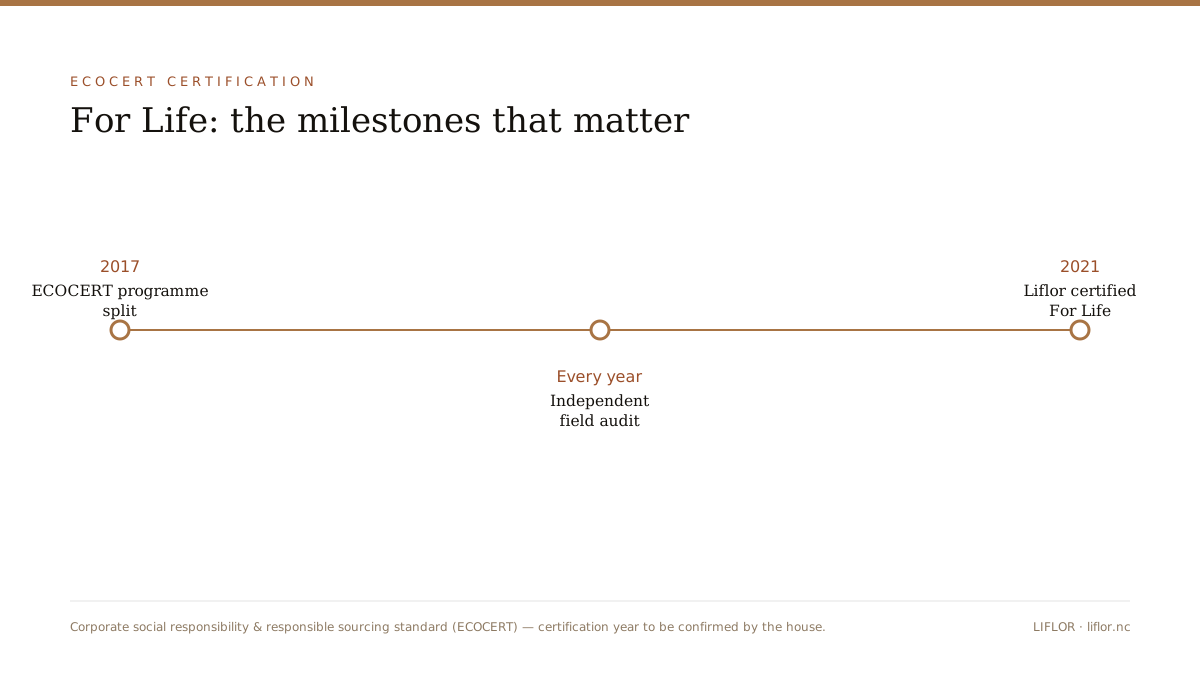
ECOCERT is an independent certification body, historically known for its organic farming labels. Its For Life standard follows a different logic: it addresses corporate social responsibility (CSR) and responsible sourcing. According to ECOCERT, the programme was split in 2017 into two complementary strands, one centred on CSR and responsible sourcing, the other dedicated to fair trade. A certified company agrees to have its social, economic and environmental practices verified by an independent third party, and to improve from one audit to the next. This is not a fixed snapshot but a controlled trajectory of improvement over time.
What the For Life standard verifies
The standard looks first at working conditions and the fairness of commercial relationships: fair pay for producers, contract transparency, no forced labour or exploitation. It then examines the environmental footprint of the activity and the safeguarding of the resource. Finally, it requires documented traceability, from the place of harvest to the shipped product. For an essential oil destined for fine fragrance, this chain of evidence matters as much as the olfactory signature: it governs whether the ingredient can enter the formulas of the great houses, which require precise knowledge of where each batch comes from.
How a For Life audit unfolds
In practice, certification rests on a cycle of audits carried out by a third-party body, independent from the company being assessed. The auditor does not simply read declarations: they combine a documentary review — contracts, pay records, harvest registers — with a field visit, as close as possible to the plots and the distillation workshop. Every discrepancy found leads to a corrective action plan, whose implementation is checked at the next visit. The control is repeated at a regular pace, usually yearly, so that a company cannot rest on compliance secured once and for all. It is this recurrence that separates a living certification from a mere statement of intent: the label does not attest to a stated ideal, but to a practice that is observed, documented and renewable from one year to the next.
A customary supply chain: pre-financing, long contracts, collective projects
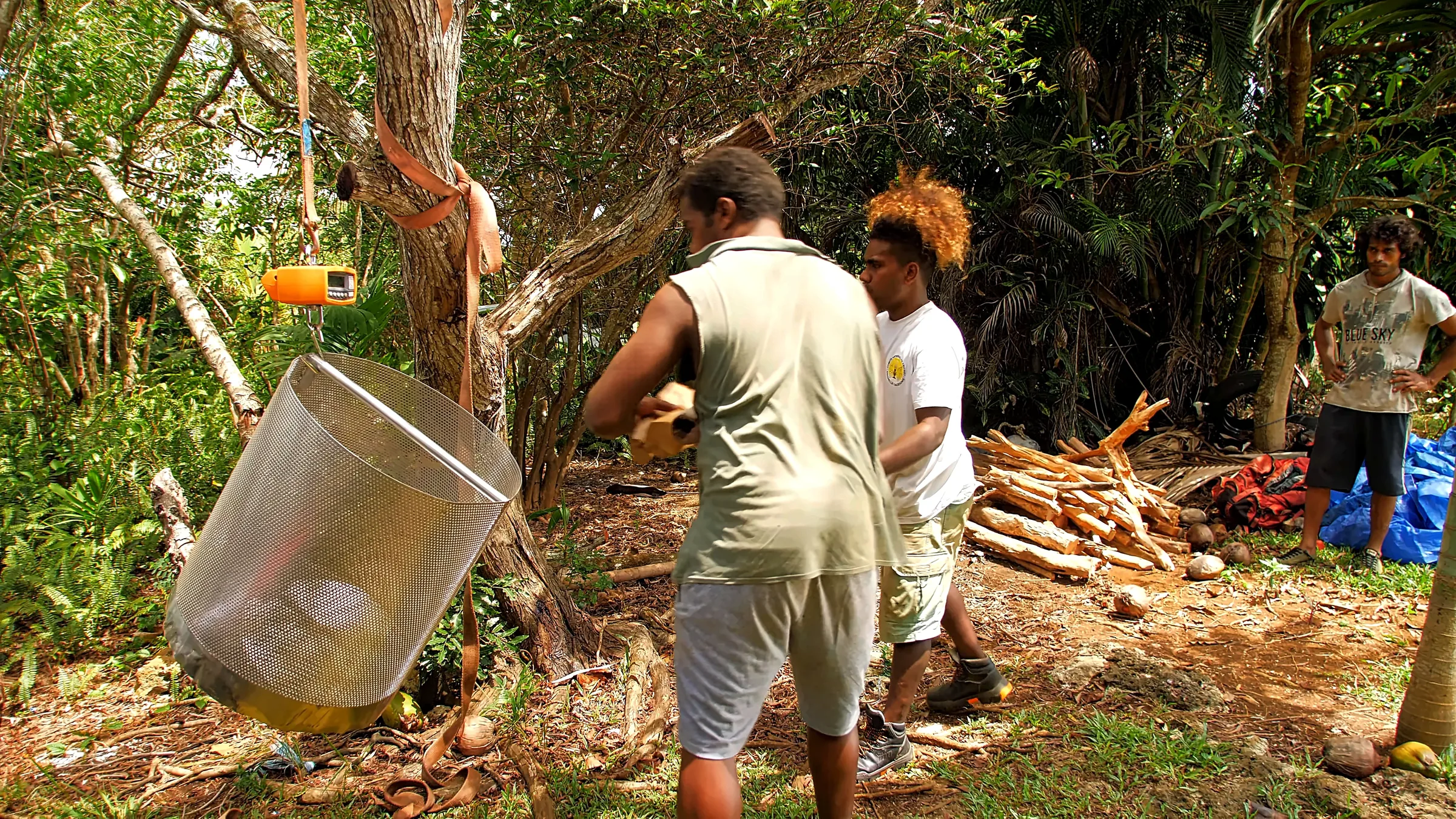
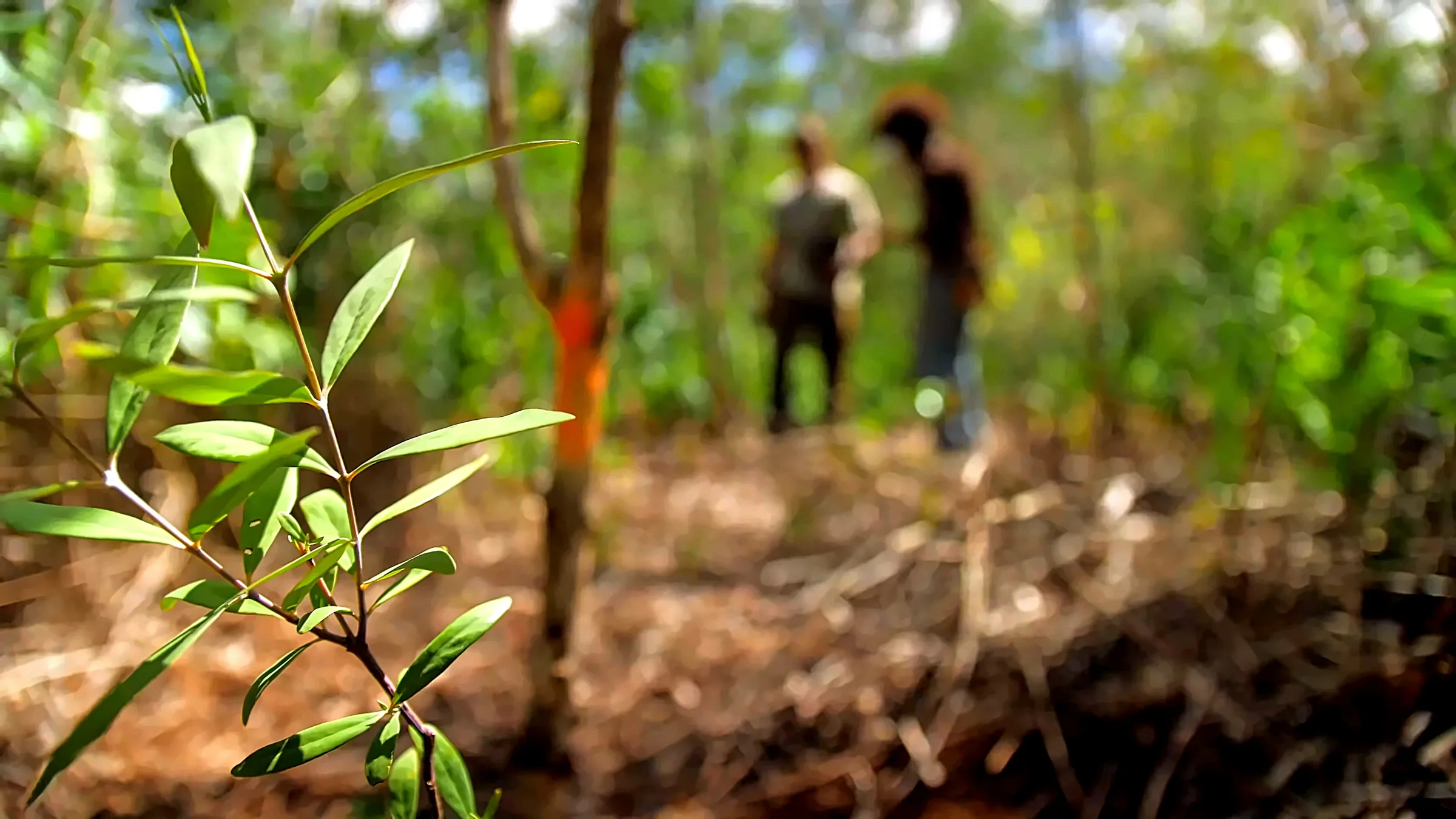
On the ground, the spirit of the standard translates into concrete commitments. Pre-financing the harvest lets customary landholders be supported before the trees are even cut, without depending on uncertain advances. Multi-year contracts secure income in a sector where the tree takes decades to mature: Caledonian sandalwood reaches maturity at around thirty years in the wild, and its harvest is considered optimal between forty and fifty years, according to the sector (Takone). A share of the value is also reinvested in collective projects decided locally, which anchors the approach in the life of the tribe rather than in a simple purchase order.
This organisation sits within a Kanak customary framework, in which land and tree fall under clan authority. The partnership formed with LMR Naturals by IFF since 2017 illustrates this rising standard: planting began in 2020, and the activity, run by an entirely Kanak company based in Chépénéhé, is For Life certified (according to IFF). The agreement with the chieftaincy is being formalised, a process handled with the care such relationships require. Here you can see what the word "responsible" really covers: not surface compliance, but governance shared with those who hold the resource.
What the For Life audit checks on the ground
Certification does not replace the law: it builds on it. In New Caledonia, sandalwood harvesting is governed by deliberation no. 2010-71/API of 19 August 2010, which sets annual quotas and provides for a resource inventory roughly every ten years (ERPA). The exploitable resource is concentrated in the Loyalty Islands and the Isle of Pines (Outremers360, 2015). To prevent the over-exploitation that has marked the species' history, the Islands Province requires three trees to be replanted for every tree cut, backed by a felling certificate (FSC, 2023).
Local processing is protected: exporting raw sandalwood is prohibited, and the export of spent wood is restricted (Outremers360, 2015). Sandalwood also remains a slow resource; across the sector, the FSC forest certification undertaken on Maré covers close to 58,000 hectares, a process launched in 2018 and completed in November 2022 (FSC). Within this dense regulatory framework, a material traced from tree to drum becomes a scarce asset, one that For Life certification documents and makes legible for a demanding buyer. You can find this framework in detail on our sustainability page.
Three trees replanted for every tree cut: the sustainability of Caledonian sandalwood is not a promise, it is a regulatory obligation (FSC, 2023).
For Life, organic label, forest certification: three markers not to be confused
A buyer mindful of sustainability navigates between markers that do not cover the same ground, and that it would be unwise to treat as equivalent. Adding them up in one's mind into a single promise would mean overstating what a material truly guarantees.
- An organic label certifies a method of cultivation — no synthetic inputs, adherence to an agronomic specification — but says nothing about social conditions.
- Forest certification, such as the FSC standard adapted to the Loyalty Islands, attests to sustainable management of the timber resource at the scale of the forest.
- ECOCERT's For Life standard addresses social responsibility and sourcing: fair commercial relationships, traceability, safeguarding of the resource and respect for people.
In a sandalwood supply chain, these three logics can stack up: the resource falls under regulated forest management, while the commercial and human relationship falls under For Life. It is precisely because no single label says everything that a discerning buyer reads the exact nature of each guarantee before entering it into their file.
Why this certification matters for fine fragrance
The global sandalwood oil market was valued at 174.4 million dollars in 2024 and could reach 261.7 million by 2030, an annual growth rate close to 7% (Grand View Research). At the same time, world demand for Santalum album stands at around 5,000 to 6,000 tonnes a year, against a supply constrained by growth cycles of fifteen to twenty years and more (Discover Applied Sciences). This scarcity fuels the risk of illegal harvesting and questionable traceability. A certification such as For Life provides precisely the documented proof that is missing elsewhere.
For a purchasing director or a perfumer, choosing certified sandalwood is not about ticking a box. It means securing a verifiable origin, method of production and story, the condition of entry into a luxury formula. This is the commitment Liflor makes for its Pacific sandalwood, set out on our certifications and sustainability pages.
The Caledonian chemotype: what a traced material secures
The value of a sandalwood in perfumery lies in its molecular signature. New Caledonian sandalwood, from the endemic species Santalum austrocaledonicum, shows a profile dominated by santalols: according to Wikiphyto, cis-α-santalol ranges between 38 and 45%, cis-β-santalol between 12 and 17%, with a notable share of lanceol (4 to 13%) and α-bergamotol, for a total of santalols close to 50 to 62% (ranges to be confirmed against the ISO 3518 standard). This chemotype is its own: it is not to be confused with Indian Santalum album, richer in santalols, nor with Australian S. spicatum. And a composition only has value for a formulator if it is reproducible from one batch to the next. This is where certified traceability becomes a technical argument as much as an ethical one: knowing that each drum comes from the same species, the same terroir and a harvest brought to maturity means having a material with stable olfactory behaviour, on which a formula can rest without unpleasant surprises.
A composition only has value for a perfumer if it is reproducible: certified traceability is not merely an ethical argument, it is a technical guarantee.
Bringing a certified sandalwood into a formula
On the houses' side, a certified material does more than dress up a sales pitch: it takes its place in a file. The For Life certificate, together with the batch's certificate of analysis and the documentation of origin, feeds the compliance file that purchasing and regulatory teams require before any integration. It reinforces the brand story — a fragrance can then claim a named, verified origin — without replacing perfumery's own obligations, in particular compliance with IFRA standards, which follow a different logic. For a finished cosmetic, the same document supports the formula's responsible communication and reassures a retail chain increasingly attentive to the upstream. The traced ingredient thus becomes an anchor point: it links the bottle on the shelf to a tree planted on a Lifou plateau, and that continuity, long invisible, turns into a commercial advantage.
Lifou, a terroir under customary authority
To situate the resource is to understand why this certification takes on, here, a particular resonance. Liflor's sandalwood grows in Lifou, the largest of the Loyalty Islands, on land governed by Kanak customary law: the plot, the tree and the authorisation to cut all sit within a clan order in which the chieftaincy has a say. A responsible approach cannot be imposed from outside; it is built with the customary landholders, respecting timeframes that are not those of the market. The same terroir, it bears repeating, yields more than precious wood: Liflor also grows Lifou vanilla there, another fruit of a patient agriculture rooted in the island. This dual activity says enough that value, here, is thought of at the scale of a territory and a community, not of a mere transaction. You then grasp what an audit documents: less an imported standard than a local way of doing things, made legible for the outside world.
Frequently asked questions
What is the ECOCERT For Life certification?
It is an independent certification issued by ECOCERT that attests to a company's social responsibility and to the responsible nature of its sourcing. Through a third-party audit, it verifies social, economic and environmental practices from harvest to finished product. According to ECOCERT, the programme has, since 2017, comprised a CSR strand and a dedicated fair-trade strand.
Is Liflor's sandalwood certified and sustainable?
Liflor is certified ECOCERT For Life. Harvesting takes place under the Loyalty Islands Province quotas, with a replanting policy and Kanak customary governance.
What is the difference between the For Life label and an organic label?
An organic label certifies a method of cultivation, in particular the absence of synthetic inputs. The For Life standard, by contrast, covers social responsibility and responsible sourcing: working conditions, fair commercial relationships, traceability and safeguarding of the resource. The two approaches are complementary.
Where is Liflor's certified sandalwood produced?
In Lifou, in the tribe of Chépénéhé (Wetr district), in the Loyalty Islands, New Caledonia. The sandalwood is harvested and distilled on its home terroir.
How often is a For Life certification checked?
The standard rests on audits carried out by an independent third-party body, renewed at a regular pace, usually yearly. Every discrepancy leads to a corrective action plan checked at the following visit, which places the certification within a logic of continuous progress rather than a one-off snapshot.
Does Caledonian sandalwood have the same composition as Indian sandalwood?
No. New Caledonian sandalwood (Santalum austrocaledonicum) has a chemotype of its own, dominated by santalols but distinct from that of Indian Santalum album as well as Australian S. spicatum. It is precisely this identity that certified traceability makes it possible to guarantee from one batch to the next.
Assessing a traced, certified Pacific sandalwood for your formulations? The detailed composition, certificates of analysis and sampling terms are available on request through our quote page.
Sourcing Caledonian sandalwood for a project? Talk to the distillery.
Request a quote