The question is no longer whether a material smells right. Before a bottle is even opened, a perfumer, a buyer or a compliance officer wants to know the exact origin of the ingredient, the legal regime under which it was harvested, and the share that returns to the communities on its home territory. Responsible sourcing of natural ingredients has become the first filter, ranked alongside olfactory quality. For a material as scarce as sandalwood, that requirement weighs heavier still.
Responsible sourcing of natural ingredients: the new baseline for luxury
For a long time, the provenance of a raw material fit on a single line of a purchase order. That era is over. Fine fragrance houses now build full sourcing files, in which every batch must be traceable to a plot, a harvest season and a management regime. The shift comes from pressures that compound one another: a resource growing scarcer, tighter regulation, and end customers who want a true story behind the scent.
The economics sharpen that tension. According to Grand View Research, the global sandalwood oil market was set to grow from USD 174.4 million in 2024 to USD 261.7 million by 2030, a compound annual rate close to 7%. Supply does not keep pace: a study published by Springer puts world demand for Santalum album at 5,000 to 6,000 tonnes a year, against a resource whose maturity cycles run beyond fifteen to twenty years. When a material becomes scarce, traceability shields the buyer from illegality and from supply disruption.
Scarcity, substitution, adulteration: why proof of species matters
A costly, coveted material invites counterfeits. On the world market, several woods circulate under names close to 'sandalwood' without belonging to the botanical genus Santalum, and oils are cut with lesser fractions to approach its scent at lower cost. Buyer searches for 'sustainable sandalwood' or 'eco sandalwood' express that very worry: finding an origin whose species itself leaves no room for doubt. The first lock of any serious traceability is therefore not the smell, but the botanical identity of the batch.
This is where chemistry settles the matter. Caledonian sandalwood, Santalum austrocaledonicum, carries a santalol signature of its own: according to Wikiphyto, its cis-α-santalol fraction sits between 38 and 45% and total santalols around 50 to 62%, figures still worth cross-checking against the ISO 3518 standard. That fingerprint, measured on every batch, sets the endemic species apart from both Indian and Australian sandalwood. For a buyer, a certificate of analysis is no formality: it is the identity card that rules out substitution.
Before it can smell right, a material must first be what it claims to be. Proof of species comes before the promise of scent.
IFRA, REACH, CITES: the regulatory gate every ingredient must clear
A fragrance ingredient must first comply with the IFRA Standards, issued by the International Fragrance Association, whose successive amendments (the 51st being the current reference) set the conditions of use for each material in a finished product. To these are added, in Europe, the REACH regulation on chemical substances and, for international trade, CITES-type controls governing commerce in certain sandalwood species. These texts say nothing about scent: they speak of safety, legality and documentation. A house evaluating a new origin first checks that it will clear these gates without reservation.
The Nagoya Protocol: who may use the resource, and who benefits?
Compliance does not stop at product safety. Since the Nagoya Protocol, adopted in 2010 under the Convention on Biological Diversity, access to a genetic resource and the sharing of the resulting benefits (ABS) have been regulated: a company using a plant must show that the country and the communities of origin consent to it and benefit from it. In New Caledonia, this logic meets a long-standing reality, since land and resource often fall under Kanak customary domain. In the Loyalty Islands, sandalwood harvesting is framed by a provincial deliberation (no. 2010-71/API of 19 August 2010, per ERPA), which sets annual quotas and requires a periodic inventory of the resource.
The Caledonian framework goes further than a mere permit. The Province des Îles Loyauté requires, according to FSC, three trees planted for every tree felled, together with a felling certificate. Export of raw sandalwood logs is moreover prohibited (Outremers360, 2015): processing must take place on the territory, which anchors the added value where the tree grows. For an international buyer, these rules are not obstacles but proofs, and they underpin a verifiable sustainability approach, document by document.
Processing on the island: when control of the method becomes the proof
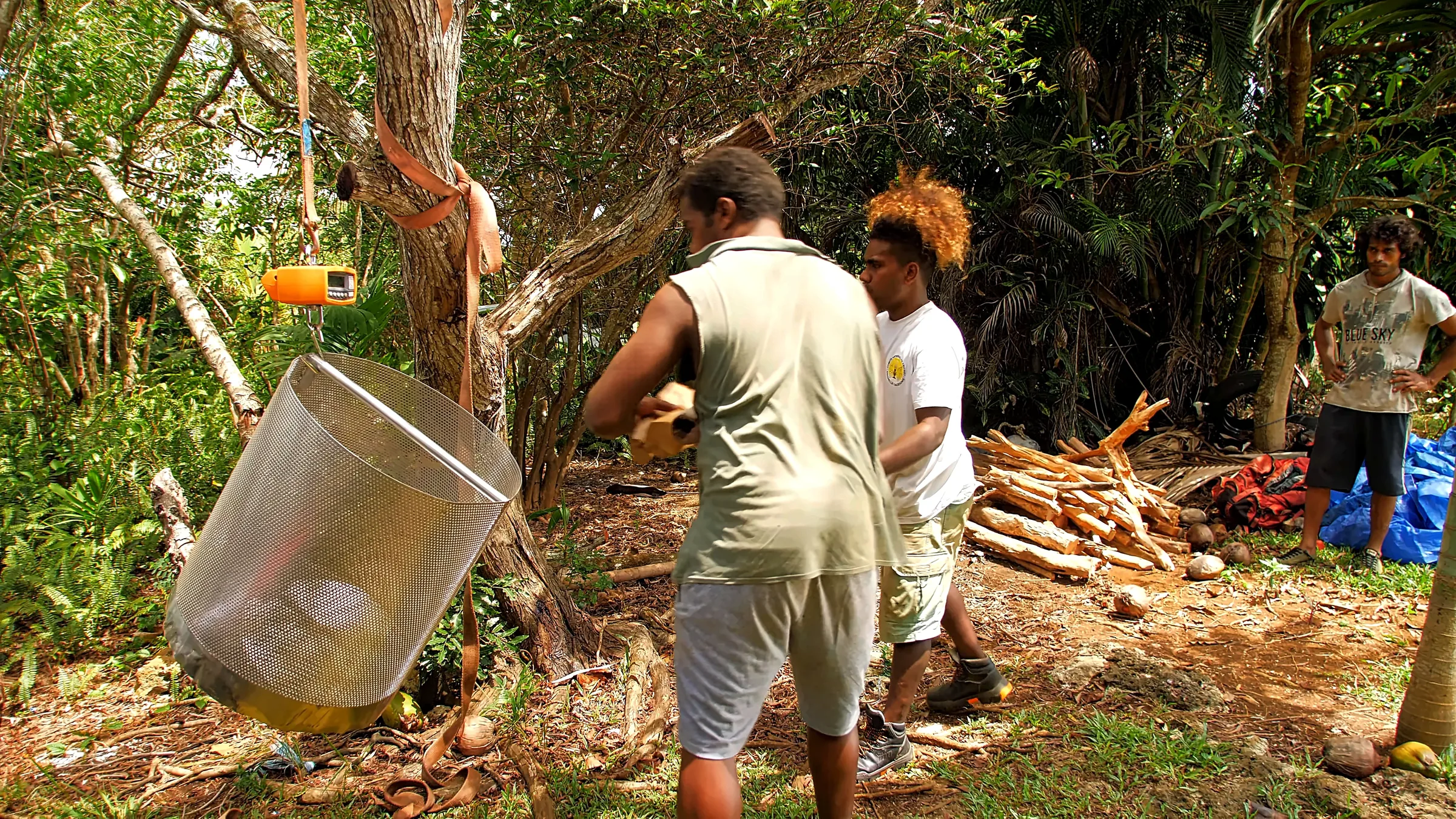
Banning the export of raw wood does not only protect the resource; it also locks in traceability. Because sandalwood must be processed on the territory, the chain does not scatter across several countries before distillation. On Lifou, the harvested wood reaches the Chépénéhé distillery, where it is reduced and then put through hydrodistillation, a method that separates the essential oil by steam. Every step takes place under one roof, cutting out the opaque links where a material can be swapped or blended.
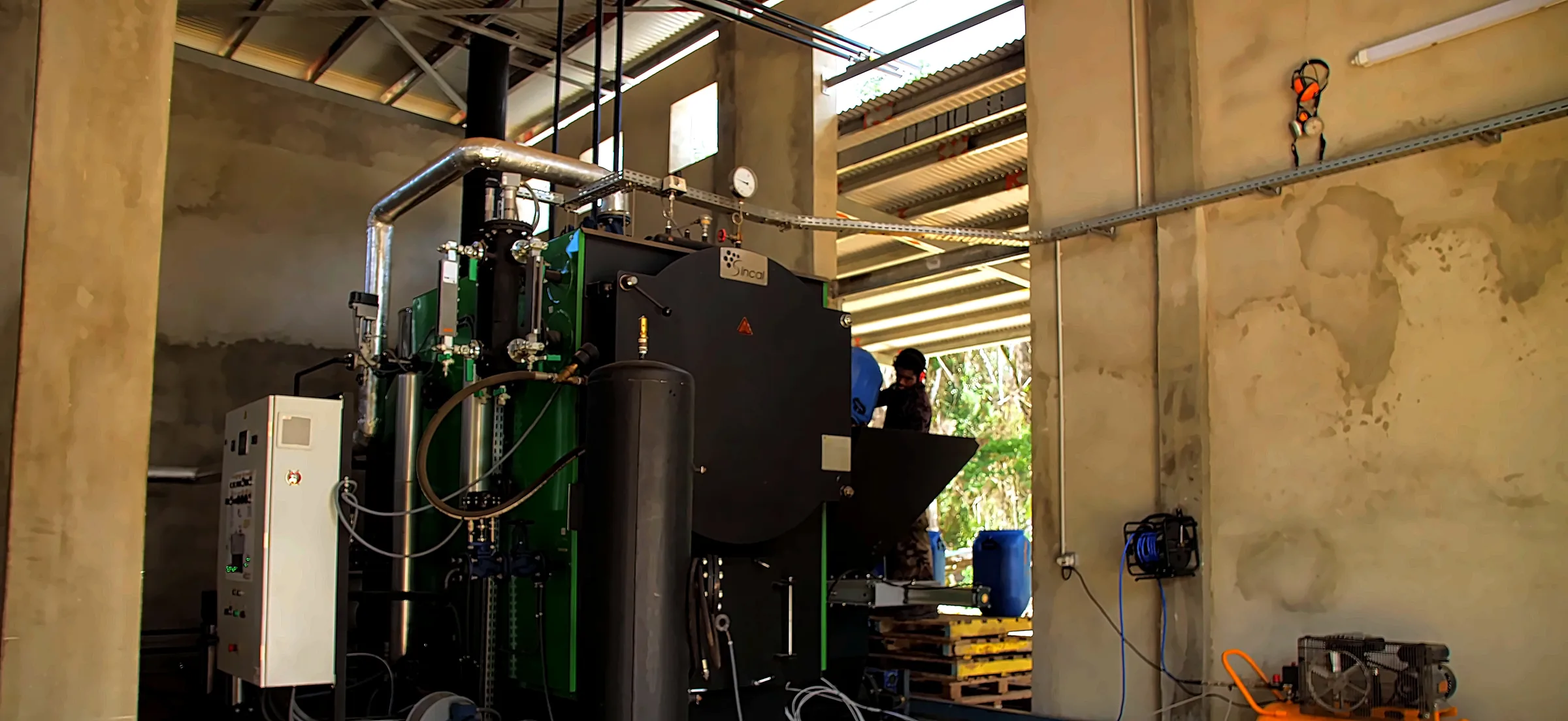
The length of the cycle is part of the proof. According to the distillery's own figures, still being validated, the hydrodistillation of Lifou sandalwood runs over 48 to 72 hours, the time needed to release the heaviest santalols without forcing them. This slow tempo, documented batch by batch, belongs to the register of our pieces on the craft of distillation: it tells, without overstating it, why an oil carries the memory of its wood. An origin that masters its own method need not subcontract the most delicate part of its story.
Global sandalwood demand runs into thousands of tonnes a year, while a single tree takes decades to mature. In that gap, traceability stops being optional.
Third-party certification: having your sourcing attested by an independent body
Faced with this demand for proof, certification acts as a trusted third party. The ECOCERT For Life standard audits the social responsibility of a supply chain and the quality of its sourcing: working conditions, fair relationships with producers, prefinancing, long-term contracts and collective projects (ECOCERT). For a material grown on customary land, this framework verifies that value genuinely returns to the communities that hold the resource. The Lifou sandalwood distillery carries this certification, which places it at once among the compliant suppliers luxury expects; the detail of its certifications is available to buyers.
This compliance cannot simply be declared. The partnership formed in 2017 with LMR Naturals by IFF, which supports the Lifou supply chain and backed the planting begun from 2020 (IFF), attests that the operation, a wholly Kanak-owned company based in Chépénéhé, meets the standards of global fine fragrance. A major buyer lends its name only to an origin whose legality and social trajectory it has tested for itself.
For Life, FSC: reading a certification without getting it wrong
Not every certification says the same thing, and confusing them exposes the buyer. The ECOCERT framework distinguishes For Life, which attests social responsibility and sourcing quality, from the organisation's separate fair-trade standard; the two programmes were split in 2017 (ECOCERT). Lifou sandalwood holds the For Life certification, that is, the first: the exact wording matters, because labelling a 'For Life'-certified ingredient as 'le volet commerce équitable d'ECOCERT' would already be an inaccuracy in a sourcing file.
At forest scale, another framework fills out the picture. In the Loyalty Islands, an FSC approach has been adapted to the island context: according to FSC, close to 58,000 hectares have been certified on Maré, a project launched in 2018, validated in 2021 and certified in November 2022. These frameworks answer one another: the forestry one guarantees stewardship of the environment, the social one attests the sharing of value. Layered together, they form the web of proof a house requires before adding an origin to its catalogue, and which the certifications page documents.
The long time of the terroir: what customary management guarantees
Behind the certificates lie a land and a rhythm. Caledonian sandalwood grows slowly: according to Takone, the tree reaches maturity around thirty years in the wild, a little earlier under plantation, and yields its finest oil later still. Harvesting such a resource without exhausting it calls for management that thinks in decades, not seasons. In the Loyalty Islands as on the Isle of Pines, the only zones where sandalwood can be worked in New Caledonia according to Outremers360, that discipline rests on the rule of three trees replanted for every tree felled.
The customary dimension is no backdrop. The resource often falls under Kanak domain, and the Chépénéhé operation is run by a wholly Kanak-owned company (IFF). The sharing of value with the community of origin is therefore not a clause added to reassure a buyer: it precedes the commercial contract. That reality, sober and verifiable, gives the origin story a footing no brand argument could manufacture.
The origin story: when traceability becomes a narrative
The final link in the chain is narrative. Luxury houses no longer ask for certificates alone; they expect a credible origin story, a provenance account the end customer can hear without any link giving way. An endemic sandalwood, harvested on one identified island, distilled on site and documented from wood to oil, supplies that story without embellishment. It must, however, rest on verifiable facts rather than on staging: this is where traceability and a compelling story finally merge.
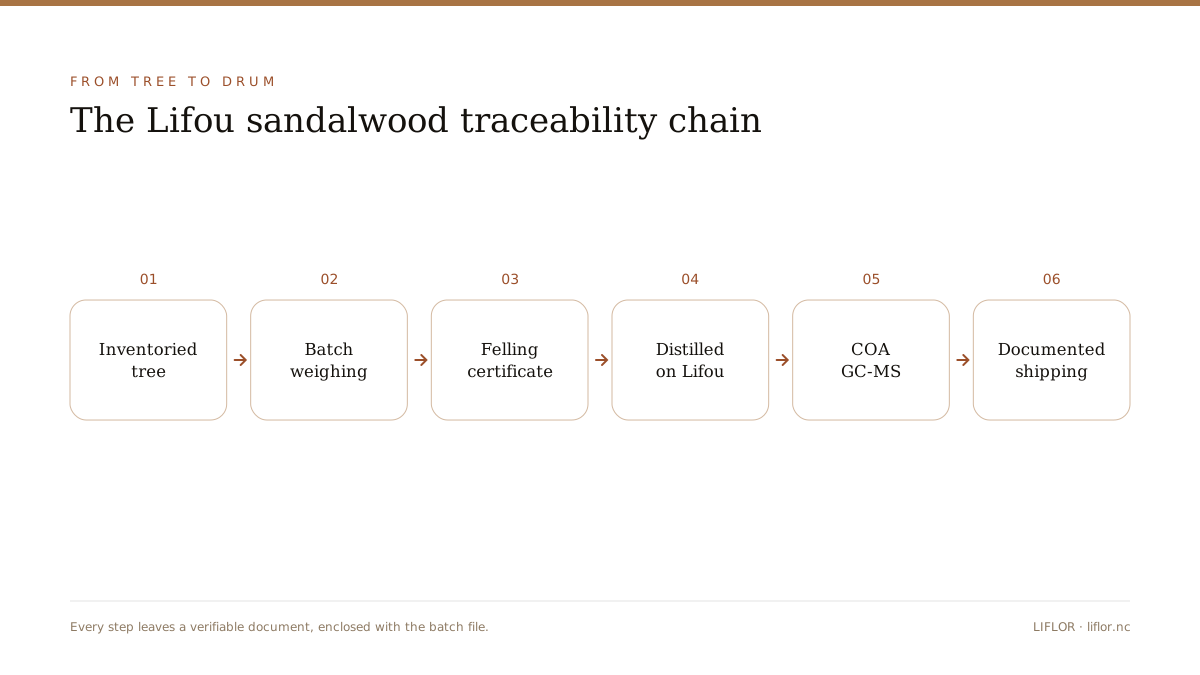
In practice, an importer sourcing Lifou sandalwood can assemble a set of documents that make the origin defensible, from the field to the drum:
- A felling certificate and Province des Îles Loyauté quotas, linking the wood to its plot of origin.
- ECOCERT For Life certification, attesting social responsibility and the sharing of value with communities.
- A certificate of analysis (COA) stating the chemotype of each batch of essential oil.

For a house building its collections on traceable materials, an already-compliant origin means saved time and reduced risk. Lifou's Caledonian sandalwood, endemic, harvested under provincial quota and distilled on its own terroir, enters sourcing files with no shortcut and no grey area. Buyers wishing to assess a batch can request a quote and a documented sample.
A buyer's method: auditing an origin, step by step
How does a sourcing manager move from a promise to a file? By working through a method that follows the thread back, from the bottle to the plot. The exercise is anything but abstract: it means asking, document after document, for whatever makes the origin defensible before a client, an auditor or an authority. For an endemic material that is already compliant, this audit runs with no blind spots.
- Identify the species: require the exact botanical name and a certificate of analysis placing the batch's chemotype.
- Check the legality of the harvest: felling certificate, provincial quotas and proof of replanting.
- Review the social dimension: For Life certification and the terms of value-sharing with communities.
- Confirm downstream compliance: the IFRA Standards in force and use documentation in the finished product.
Nothing in this list is specific to one house: it is the ordinary protocol of luxury faced with a natural ingredient. What changes from one origin to the next is the ease with which each box is ticked. An endemic sandalwood, harvested under quota and distilled on its own island, clears these four steps with continuous documentation, with no link that forces the eye away.
Frequently asked questions
Does the Nagoya Protocol apply to New Caledonian sandalwood?
The Nagoya Protocol governs, at international level, access to genetic resources and the sharing of benefits (ABS). In New Caledonia this logic combines with Kanak customary law and provincial regulation: the operator must show that the resource is harvested legally and that value returns to the communities of origin. The precise arrangements fall under provincial frameworks and should be verified case by case.
How do you prove that a sandalwood is responsibly sourced?
The proof rests on a documentary chain: a felling certificate and Province des Îles Loyauté quotas, ECOCERT For Life certification for social responsibility, and a certificate of analysis for each batch. Together, these let a buyer trace the oil from the plot to the drum.
Does Liflor work with major fragrance houses?
Yes. The Lifou supply chain has partnered with LMR Naturals by IFF since 2017, a collaboration that supported the planting begun from 2020 (IFF). This partnership attests that the origin meets the standards of fine fragrance.
Can this sandalwood be ordered internationally in full compliance?
Yes. Liflor sells B2B internationally, packs in drums and ships worldwide, with the traceability and certification documentation that luxury expects. Pricing is provided on request.
What is a 'sustainable' sandalwood, and how do you tell it from a 'green sandalwood'?
A sustainable sandalwood is an oil from a species of the Santalum genus, harvested legally, under quota and with replanting, and whose origin is documented from wood to drum. The term 'green sandalwood', common in the trade of objects, often refers to woods that do not belong to that botanical genus: hence the importance of the certificate of analysis, which fixes the batch's species and chemotype.
What exactly does the For Life certification cover?
No. Within the ECOCERT framework, For Life attests social responsibility and sourcing quality, while le volet commerce équitable d'ECOCERT targets fair trade; the two programmes were split in 2017. Lifou sandalwood is certified For Life: it is this exact wording that should appear in a sourcing file.
Traceability is not a constraint to be endured: it is how a slow-growing resource proves its worth to those who work it downstream.
Sourcing Caledonian sandalwood for a project? Talk to the distillery.
Request a quote